Thinking Is Slow. Copying Is Fast.
Nearly all behavior of biological species is a result of what is effectively the giant reinforcement learning algorithm in nature. It incentivizes the generation of agents with behaviors that are more likely to reproduce.
In hostile, changing environments, adapting to a new environmental pressure is often crucial to a gene’s chances of continuing through time.
Species currently have four means of adopting new behaviors, with trade-offs between speed of adoption and speed of active use.
Speed of adoption is how quickly a species, or an individual member of a species, can learn a new behavior. Speed of active use is how quickly an individual can carry out a behavior when it is called to do so.
Here are the four means of adopting new behaviors, by speed of adoption:
-
Positive selection for genes encoding new innate behaviors (slowest adoption, fastest active use). It took many millennia for animals to adopt behavior to respire using oxygen from the atmosphere. Barring some major disability or injury, anyone can breathe in quickly without conscious thought.
-
Pavlovian reinforcement mechanisms (slow adoption, fast active use). The organisms of many species can be induced to quickly act a certain behavior when it has been strongly associated, over a period of its lifetime, with a reward or punishment. Pavlov demonstrated how ringing a bell in the presence of a dog feeding can, after several repeat incidents, induce a dog to start salivating upon hearing the ringing of that bell. Nature has allowed for the shortening of the reinforcement learning mechanism from generational timescales to the timescale of an individual organism.
-
Copying others (medium adoption, fast active use). Humans are (probably) unique in learning new behaviors by watching and repeating what others do. Nature again speeds up the reinforcement learning mechanism by allowing for the transference of learnings by other organisms.
Most of our skills are learnt from copying others. Children learn from adults how to tie their laces. This is much faster than each child having to use logic to deduce a knot that will keep their shoes firmly attached to their feet, or to go through the entire Pavlovian process of randomly trying knots until they learn that a certain knot keeps their shoes on.
-
The application of conscious logical thought (fastest adoption, slowest active use). Behaviors that are the consequence of logical thought have the fastest adoption. They do not need any historical examples to be learnt; they can be deduced from first encounter. They have the slowest active use. It can take a lot of time and brainpower to deduce, in a novel scenario, the desired behavior.
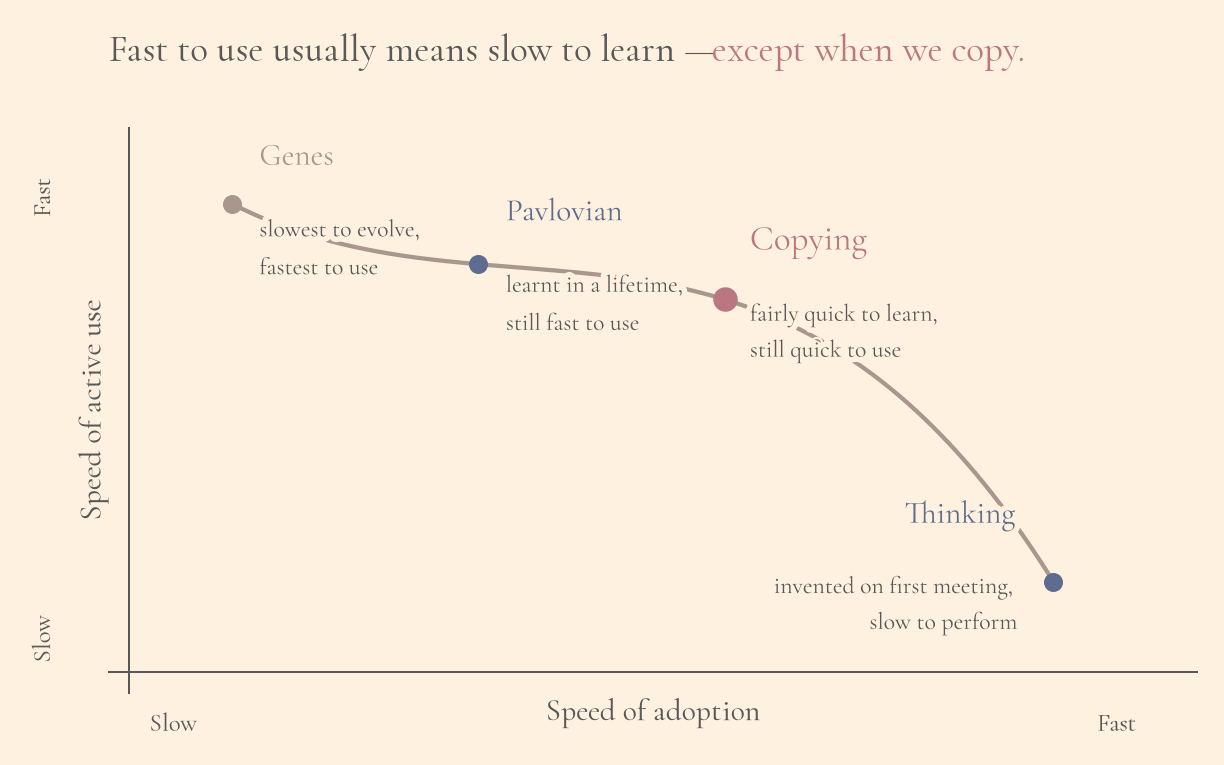
What put the human species in its current dominant position on earth is its ability to accelerate the adoption of new behaviors. It does this by the synthesis of conscious logical thought and the innate imitation of the behaviors of others.
Behavioral imitation is especially powerful. As soon as one individual can, either by random experimentation or the application of conscious logical thought, perform some new behavior that leads to a great increase in utility, others can imitate and also benefit from this successful behavior.
Humans also put that mimetic instinct to work by copying people they see as higher-status. As a teenager, Napoleon read everything he could about Julius Caesar, who had idolized Alexander the Great. Erling Haaland shaped his football on Cristiano Ronaldo; Coco Gauff did the same in tennis with Serena Williams; Oprah Winfrey modeled herself on Maya Angelou.
High status usually goes with wealth: the ability to command resources. In our evolutionary history, the behaviors a high-status person enacted were often what won them that advantage in the first place.
In a sprouting agrarian society, anyone who could imitate the farmer with the bountiful harvest’s use of the first primitive plough would accrue for themselves the same advantage. In the same way, Haaland, by following Ronaldo’s techniques, scores more goals – value for himself and his team.
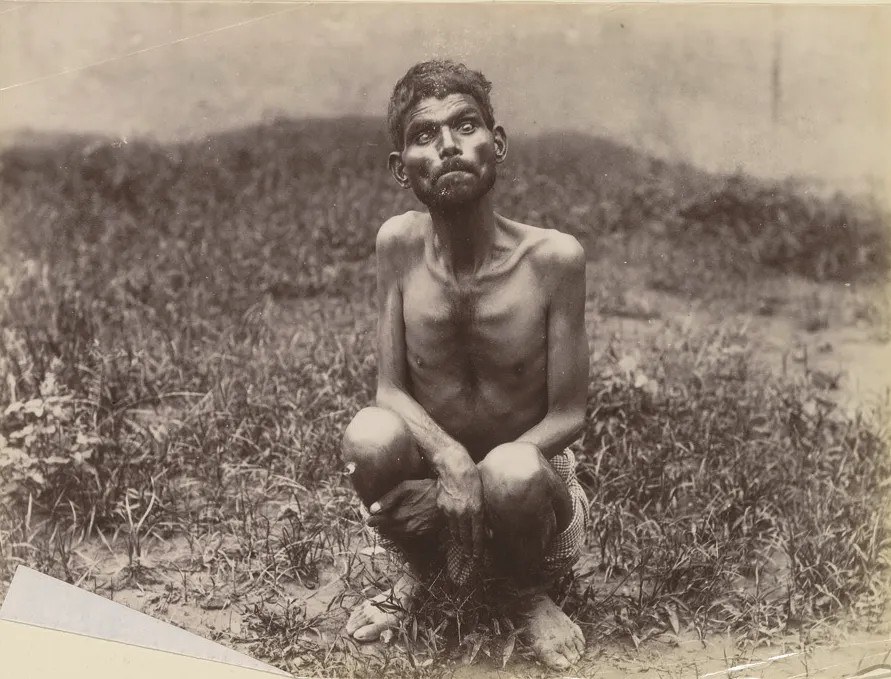
This instinct is so powerful in humans that we have even displayed the capacity to learn from other species. There are incidents of feral children walking on all fours and eating raw meat after being raised by wolves.
Next week I will write about what culture is and how it spreads.